

NAC and Glutathione: The Amino Acid the Supplement Industry Is Not Telling You About
- templefoods9
- Apr 11
- 9 min read
The Supplement Industry Told You a Lie About Glutathione
Not through misinformation, exactly. Through selective truth.
Here is what they told you: cysteine is the rate-limiting amino acid in glutathione synthesis. NAC supplies cysteine in a bioavailable form. Therefore NAC raises glutathione. Take NAC.
That logic is technically correct. And strategically incomplete — because in the majority of adults eating a modern diet, cysteine is not the actual bottleneck. The bottleneck is glycine. And most NAC products ignore glycine entirely.
Think of NAC as a bare neodymium magnet. You know the type — the rare-earth kind, dramatically more powerful than anything made from regular iron. Extraordinary potential. But raw, unhoused, a bare neodymium magnet is almost unusable: it snaps to metal surfaces unpredictably, shatters on contact with other magnets, traps fingers. The power is genuine. Without the right casing, that power cannot be applied properly.
Glycine is that casing. It is the third amino acid in glutathione — the one that completes the molecule at the final synthesis step. Without it, your NAC supplementation is doing something. But it is not doing what the label implies.
The Lie: Cysteine Is Not the Bottleneck
Glutathione is a tripeptide: three amino acids — cysteine, glutamate, and glycine — assembled in two enzymatic steps. Step one: cysteine and glutamate combine under the enzyme glutamate-cysteine ligase (GCL) to form gamma-glutamylcysteine. Step two: gamma-glutamylcysteine and glycine combine under glutathione synthetase (GS) to form glutathione (GSH).
The supplement industry focused on cysteine for legitimate reasons. Cysteine is genuinely unstable — it oxidises easily in food and in the gut. Its bioavailability from diet is poor. NAC, the acetylated form, is absorbed efficiently and converted to cysteine inside cells. The biochemistry is sound.
The error is in assuming step one is always the rate-limiting step.
In 2011, researchers at Baylor College of Medicine led by Dr. Rajagopal Sekhar measured glutathione levels and amino acid profiles in elderly subjects. They found something the industry had overlooked: subjects with the lowest glutathione had adequate cysteine. What they lacked was glycine. When the team supplemented both glycine and NAC together — rather than NAC alone — glutathione levels rose by 94.6% in eight weeks.[1]
Later work from the same group replicated the finding in middle-aged adults, in people with type 2 diabetes, and in obesity-related metabolic dysfunction.[2][3] The consistent pattern: glycine depleted. Cysteine often not. The supplement industry built a category around fixing the wrong deficiency.
Why Your Body Is Starving for Glycine
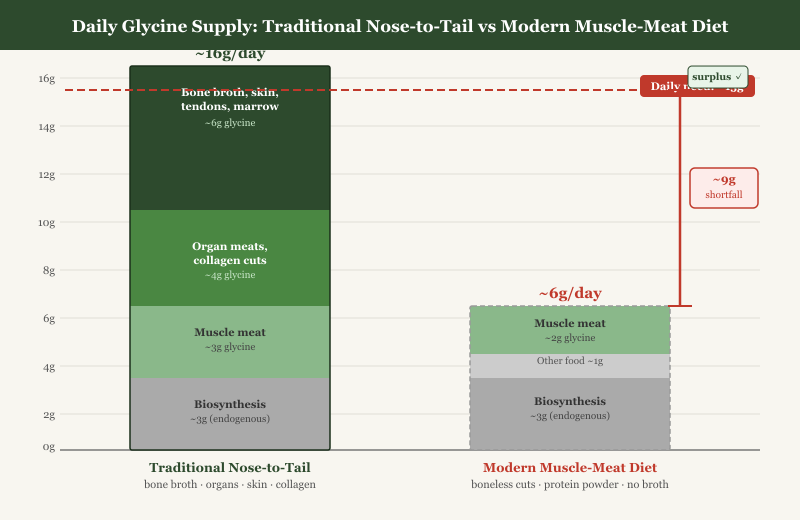
The glycine depletion is not mysterious once you understand what changed in the human diet over the last century.
Glycine is the most abundant amino acid in collagen — constituting roughly one-third of every collagen molecule. Collagen is the structural protein of skin, tendons, ligaments, bones, cartilage, and the gut lining. For most of human history, these tissues were eaten. Nose-to-tail eating meant bone broth simmered for hours, skin roasted onto the meat, tendons in stews, organ meats as staples, marrow split from bones. These cuts are extraordinarily rich in glycine.
A traditional diet provided roughly 10–13 grams of dietary glycine per day. Your body synthesises an additional 3 grams from serine and threonine. Total daily supply: 13–16 grams.
A modern diet centred on muscle meat — boneless chicken breast, lean mince, processed protein powders — provides 3–5 grams of dietary glycine. Add biosynthesis: total available drops to 6–8 grams daily.
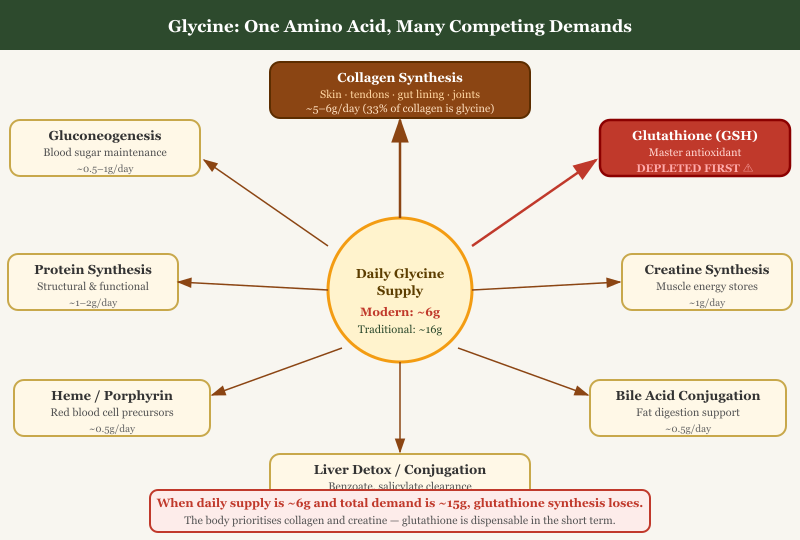
The body has roughly 10 grams of daily glycine demand beyond what biosynthesis covers. Traditional diets met it. Modern diets fall 5–10 grams short, every single day. Glutathione synthesis is the casualty no one talks about.
How Glutathione Is Actually Made
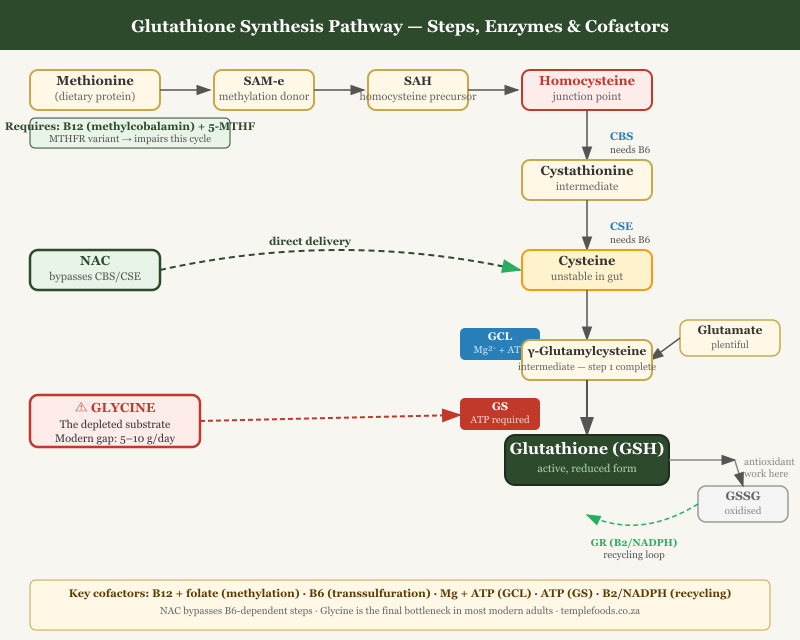
The pathway matters because it tells you exactly what to supplement alongside NAC — and what nutrient cofactors determine whether the pathway runs at all.
Everything starts with methionine, an essential amino acid from dietary protein. Methionine enters the methylation cycle, which requires vitamin B12 (as methylcobalamin) and folate (as 5-MTHF) to function. This cycle converts methionine through S-adenosylmethionine (SAM-e) and S-adenosylhomocysteine (SAH) to homocysteine. Disruption here — from B12 deficiency, MTHFR gene variants, or folate depletion — elevates homocysteine and compromises everything downstream.
Homocysteine is then directed through the transsulfuration pathway: homocysteine → cystathionine (enzyme: CBS, requires B6) → cysteine (enzyme: CSE, requires B6 again). NAC bypasses this entire route, delivering cysteine directly into cells — which is why it works even in B6-deficient individuals. But it does not bypass the glycine requirement at step two.
Once cysteine is available, GCL assembles cysteine and glutamate into gamma-glutamylcysteine. This step requires ATP and magnesium — low magnesium, endemic in modern diets, directly impairs it. Finally, glutathione synthetase adds glycine to gamma-glutamylcysteine to produce GSH. This step also requires ATP.
After GSH performs its antioxidant work — donating electrons to neutralise reactive oxygen species — it becomes oxidised glutathione (GSSG). Glutathione reductase reconverts GSSG back to GSH using NADPH, which depends on riboflavin (B2). This recycling loop is why B-vitamin status matters not just for synthesis but for sustaining the glutathione pool you already have.
Every arrow in this pathway has a cofactor. NAC addresses one input. Glycine addresses another. Neither is optional.
NAC Without Glycine: A Magnet Without a Case
Return to the neodymium magnet. Engineers do not use bare neodymium magnets in motors, generators, or speakers — they design precision housings that direct the magnetic force toward a specific, productive purpose. The raw magnet has all the power. The casing makes it useful.
NAC without glycine is similar. You are flooding cells with cysteine. In a glycine-replete person, that cysteine moves efficiently into glutathione. In a glycine-depleted person — which describes most modern adults — the GS enzyme at step two is waiting for a substrate that is not there in sufficient quantity. The cysteine is redirected into other pathways. The glutathione response is blunted. You are pushing on step one of a two-step reaction and wondering why the output is disappointing.
The Sekhar protocol that achieved a 94.6% glutathione increase used both: 1.2 grams NAC per day plus 8 grams glycine per day in elderly subjects. A 2023 follow-up found that the combination improved mitochondrial function, reduced oxidative stress biomarkers, and reversed multiple hallmarks of biological ageing — effects that neither supplement produced in isolation.[4]
The magnet works as designed. It just needs the case.
How to Supplement This Properly
The protocol is straightforward, and glycine is the least expensive amino acid available.
Glycine: 10–15 grams daily. This is not a small amount — most people get 3–5 grams from diet alone. Glycine powder is inexpensive, slightly sweet, and dissolves readily in water or coffee. It has no established upper tolerable intake limit; the body distributes it across too many critical pathways for surplus to accumulate harmfully at these doses. Take it in water, coffee, or food. Timing is flexible.
NAC: 300–1,200 mg daily. Temple Foods NAC is 300 mg per capsule. One to two capsules daily is appropriate when paired with adequate glycine. Higher doses are used clinically for acetaminophen overdose and severe oxidative stress, but for daily glutathione optimisation, 600–1,200 mg is sufficient once the glycine substrate is in place.
Vitamin C: 500–1,000 mg daily. Vitamin C regenerates oxidised glutathione (GSSG) back to active GSH via an indirect recycling mechanism. It does not replace glycine, but it extends the effectiveness of the glutathione you make. It is also the cheapest intervention on this list.
Magnesium: 300–400 mg daily (glycinate or malate form). Required by GCL at step one. If you are supplementing NAC without magnesium and your levels are low, you may be limiting the first synthesis step even before you reach the glycine bottleneck at step two.
What to Prioritise Before You Think About Glutathione
Glutathione is an optimisation. It is not a foundation. If you are struggling with fatigue, brain fog, persistent illness, or poor recovery, the most likely culprits respond to simpler interventions you will actually feel.
Vitamin B1 (thiamine). Thiamine runs every step of neurological energy metabolism. Subclinical deficiency — common in people who drink alcohol, eat refined carbohydrates regularly, or take metformin — produces fatigue, brain fog, and cognitive sluggishness that is almost instantly reversible with B1 repletion. Nothing in the glutathione stack does this. Fix B1 first and you may find the fog you thought required NAC disappears on its own.
Lactobacillus reuteri. L. reuteri has largely vanished from the modern gut microbiome due to antibiotic use and processed food. It drives oxytocin production via the gut-brain axis, affecting mood, sleep quality, and social motivation in ways people consistently describe as qualitative and noticeable within weeks. This is not a subtle optimisation — it is a restoration of something that should not have been missing. Glutathione does not touch this axis.
Methylated B vitamins. The MTHFR gene variant is carried by approximately 40% of the population and impairs conversion of folic acid to active methylfolate. The downstream effects include impaired methylation, elevated homocysteine, reduced neurotransmitter synthesis, and poor cellular energy. Methylated B vitamins address this directly — and as the pathway diagram shows, adequate B12 and folate are also prerequisites for healthy cysteine production upstream of the glutathione system. Getting methylation right serves the glutathione pathway too.
Vitamin D3 with K2. Vitamin D receptors exist throughout every organ system. The vast majority of indoor-living South Africans are deficient despite living in a sun-rich country. D3 deficiency impairs immune function, muscle recovery, mood regulation, and calcium metabolism simultaneously. Of all the foundational supplements, D3 is the one most likely to produce a noticeable change in energy and immune resilience within two to four weeks.
Fix these four first. Then layer in NAC and glycine as the second tier — targeted at oxidative stress, liver support, and cellular ageing.
A Note on What Is in the Capsule
Temple Foods NAC includes a complementary herbal blend alongside the 300 mg NAC. These additions are functional — chosen to support the NAC mechanism, not to fill capsule space. Details are on the product label.
What you will not find is silicon dioxide, titanium dioxide, magnesium stearate, or microcrystalline cellulose. These are the flow agents and binders that reduce manufacturing friction. They serve factories. The standard applied here is simple: nothing goes in the capsule that would not be there if manufacturing cost were not a consideration.
Frequently Asked Questions
Is glycine really the bottleneck, or is this just one study?
Multiple independent groups have replicated the finding. Sekhar's 2011 Baylor study, the 2021 extension in middle-aged adults, and the 2023 mitochondrial ageing study all show the same pattern: NAC plus glycine raises glutathione substantially more than NAC alone, and glycine depletion is common in modern adults across different age groups and metabolic conditions. This is not fringe science — it is increasingly mainstream in ageing and redox biology research, even if supplement marketing has not caught up.
How much glycine do I actually need daily?
The body's total daily glycine demand across all pathways is estimated at 15–18 grams. Biosynthesis contributes roughly 3 grams. Traditional diets covered the remaining 12–15 grams through collagen-rich foods. Modern diets supply 3–5 grams from food, leaving a gap of 7–10 grams. I recommend 10–15 grams of supplemental glycine per day — not because the research protocols used this exact dose, but because most people need to close a substantial existing shortfall before the surplus reaches the glutathione pathway. There is no established upper tolerable intake limit for glycine.
Can I get enough glycine from food instead?
Yes, with deliberate effort. Bone broth simmered 8–12 hours provides 3–5 grams per 250 ml cup. Pork skin, chicken skin, oxtail, trotters, and other collagen-rich cuts are excellent sources. Unflavoured gelatine powder provides roughly 2.6 grams per teaspoon. If you eat these foods regularly, your glycine intake may already be meaningful — supplement only what food does not cover. If your diet is muscle-meat centred, powder is more practical than restructuring every meal.
Should I take NAC and glycine at the same time?
It is not strictly necessary — both have reasonably long half-lives and the synthesis pathway is not a timed reaction requiring simultaneous arrival. But taking them together with food is practical and ensures both substrates are available in the same absorption window. The clinical protocols used both at the same meal. Consistency matters more than timing precision.
What about taking glutathione directly instead of building it?
Oral glutathione has poor bioavailability — it is broken down in the gastrointestinal tract before reaching cells. Liposomal glutathione has better absorption but is significantly more expensive and the evidence base is less robust than for the precursor approach. S-acetylglutathione resists gut breakdown, but is expensive and long-term evidence is limited. For most people, building glutathione from precursors — NAC, glycine, magnesium, B vitamins — is more cost-effective and has stronger clinical evidence behind it.
Does Temple Foods NAC contain fillers?
No. Temple Foods NAC contains N-acetylcysteine (600 mg) plus a complementary herbal blend. No silicon dioxide, no titanium dioxide, no flow agents or binders. The herbal additions are functional. Check the label for the full ingredient list.
Going Deeper: The Glutathione Article
This article focused on NAC as a glutathione precursor and the glycine problem. If you want to understand what glutathione actually does once you have made it — its role in liver detoxification, cellular ageing, cancer prevention, and immune function — that is the subject of a longer dedicated piece.
The glutathione article covers: what oxidative stress actually means at the cellular level, why the liver prioritises glutathione above every other antioxidant, how glutathione depletion drives the progression of non-alcoholic fatty liver disease, and what the evidence actually says about glutathione and biological ageing. If you have been taking NAC purely for liver support without understanding the mechanism, that article will reframe how you think about the entire protocol.
Coming next: Glutathione — The Master Antioxidant Your Liver Cannot Live Without.
Comments