

Lion's Mane Mushroom: Brain Benefits Backed by Science
- templefoods9
- Apr 10
- 9 min read
Your Great-Grandmother Didn't Need a Mushroom Capsule
Your great-grandmother never took a Lion's Mane capsule for brain fog. She didn't have brain fog. That should tell you something.
She worked, remembered names, thought clearly, and aged with her mind intact — without a single adaptogenic mushroom supplement in the house. The question worth asking isn't "does Lion's Mane work?" The real question is: why do so many people today feel like they need it?
I sell Lion's Mane through Living Labs. I'll be upfront about that. But I don't take it myself — and I want to explain why, because I think the honest answer serves you better than the marketing copy does.
What Lion's Mane Actually Is
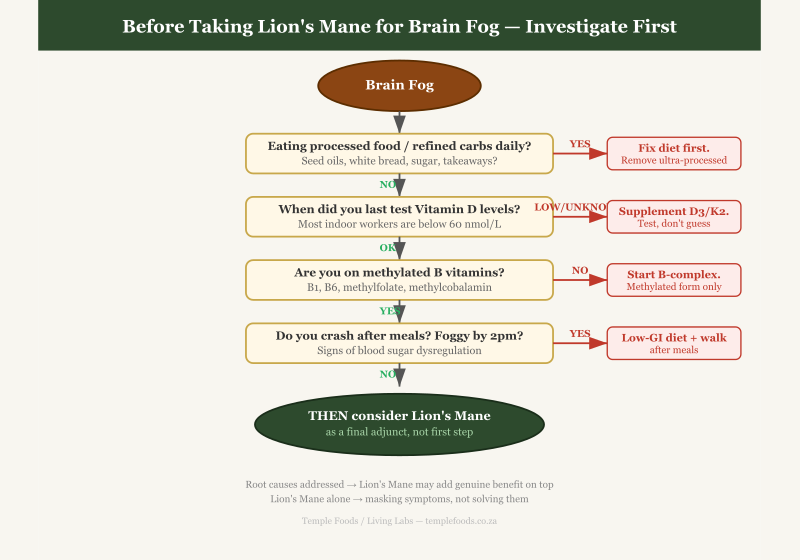
Hericium erinaceus is a culinary and medicinal mushroom that has been used in East Asian traditional medicine for centuries. It contains two families of bioactive compounds unique to this species: hericenones (found in the fruiting body) and erinacines (found in the mycelium). These compounds are believed to stimulate nerve growth factor (NGF) synthesis — a protein that supports the growth, maintenance, and survival of neurons.
The research is real and interesting. A double-blind, placebo-controlled trial published in Phytotherapy Research (2009) by Mori et al. found that adults aged 50–80 with mild cognitive impairment showed improved cognitive function scores after taking 1,000 mg of Lion's Mane three times daily for 16 weeks — compared to placebo. The effect reversed when they stopped supplementing.[1]
A 2020 pilot study in the Journal of Alzheimer's Disease found benefits for mood and sleep in adults with overweight and obesity.[2] A 2023 study from the University of Queensland found that lion's mane extract promoted neurite outgrowth (nerve cell growth) in lab conditions.[3]
So yes — there is genuine science here. This isn't snake oil. But interesting science and your best option are two very different things.
The Modern Deficiency Test
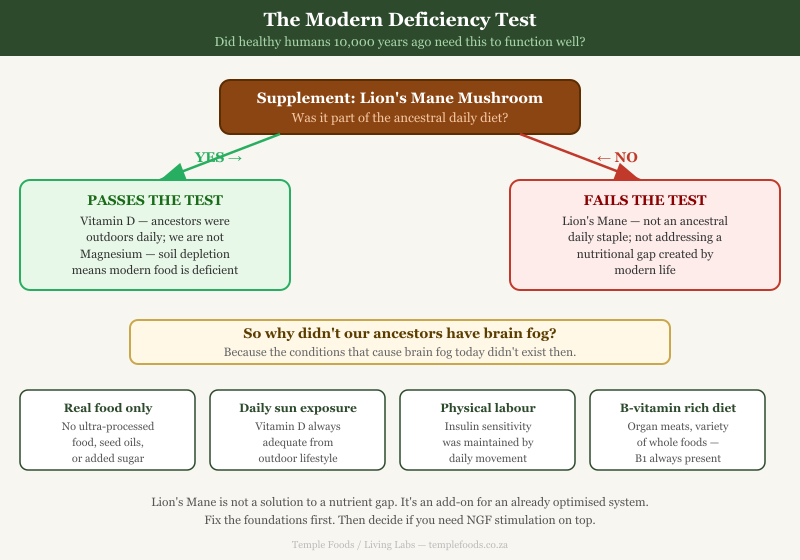
Here is the question I ask before recommending any supplement to anyone: Did healthy humans 10,000 years ago need this to function well?
Think of it like testing a new piece of gym equipment. If your grandfather built a strong, functional body without it, you should ask whether you actually need the gadget — or whether you just need to fix what's broken in your current routine.
Vitamin D passes the test with an asterisk: our ancestors spent most of their day outdoors under direct sunlight, synthesising adequate D3. Modern office life means most South Africans are borderline deficient even in Pretoria. The deficiency is real; the supplement addresses a real gap.
Magnesium passes: modern soil depletion and processed food mean most of us get a fraction of what pre-agricultural diets provided. The supplement replaces what's missing.
Lion's Mane fails the test.
Our ancestors weren't eating Lion's Mane mushrooms every day. They weren't supplementing with NGF stimulators. And they didn't have epidemic levels of brain fog, memory loss at 40, anxiety disorders, or crushing cognitive fatigue. They were mentally sharp because they ate real food, slept properly, moved their bodies, weren't bombarded with inflammatory seed oils and glucose spikes, and weren't deficient in the basic nutrients that run the human brain.
Lion's Mane is being asked to fix something that shouldn't be broken in the first place. The question is: what broke it?
Brain Fog: What's Actually Causing It
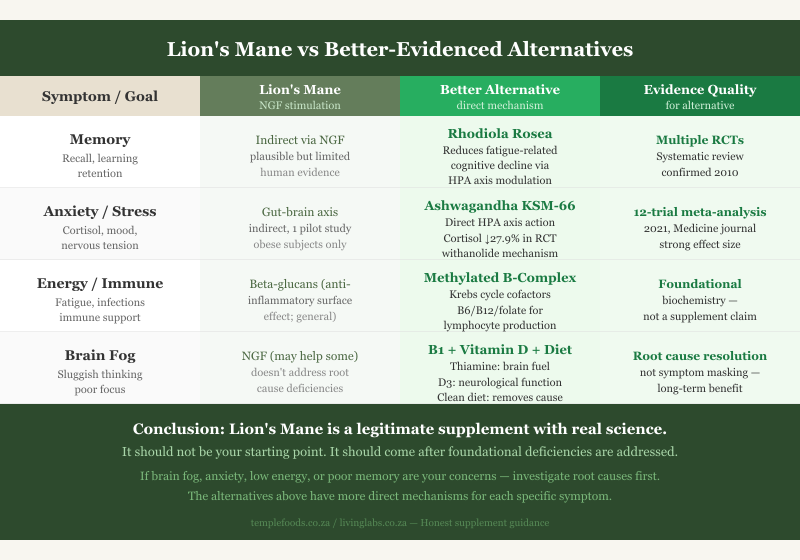
Brain fog is not a Lion's Mane deficiency. Taking Lion's Mane for brain fog is like changing the battery in the smoke alarm while the house is on fire. It might quiet the beeping. It does nothing about the flames.
Here are the most common root causes of brain fog — the ones your doctor may not test for and that Lion's Mane doesn't fix:
1. Vitamin B1 (Thiamine) Deficiency Thiamine is the engine fuel for your brain's energy metabolism. Every neuron runs on glucose metabolism — and every step of that process requires B1 as a cofactor. Subclinical thiamine deficiency (common in people who drink alcohol, eat a lot of refined carbohydrates, or take metformin) produces exactly the symptoms people describe as brain fog: mental sluggishness, poor concentration, fatigue, and low mood. A high-dose B1 protocol has reversed neurological symptoms in patients with documented deficiency.[4] No mushroom does this.
2. Poor Methylation (MTHFR Variants) Approximately 40% of people carry a variant of the MTHFR gene that reduces their ability to convert folic acid into active methylfolate. Poor methylation impacts dopamine, serotonin, norepinephrine, and the myelin sheath around your nerves. The result is brain fog, anxiety, fatigue, and poor memory. The fix is methylated B vitamins — not a mushroom.[5]
3. Vitamin D Deficiency Vitamin D receptors are found throughout the brain. Low D3 is associated with cognitive decline, depression, and poor concentration. Studies suggest optimal neurological function requires levels above 60 nmol/L — which a large proportion of indoor-living South Africans don't reach.[6]
4. Insulin Resistance and Blood Sugar Dysregulation The brain is the most glucose-dependent organ in your body. Chronically elevated insulin, blood sugar crashes after high-carb meals, and impaired glucose uptake in neurons create exactly the "afternoon fog" pattern most people experience. No supplement fixes this. A low-glycaemic diet does.[7]
5. Processed Food and Inflammatory Diet Ultra-processed food is pro-inflammatory. Seed oils and refined carbohydrates drive neuroinflammation. Lion's Mane doesn't undo neuroinflammation caused by a diet of biscuits, margarine, and white bread. Removing those foods does.
Memory Issues: Rhodiola Rosea Is Better
One of Lion's Mane's most cited benefits is memory enhancement. The NGF-stimulating compounds are theorised to support synaptic plasticity — the brain's ability to form new connections. This is biologically plausible. But here's the honest comparison:
Rhodiola rosea (golden root) has been studied more extensively for cognitive function under stress than Lion's Mane. A 2000 study published in Phytomedicine showed that Rhodiola improved mental performance, short-term memory, attention, and concentration in students during exam stress — a real-world condition rather than a lab model.[8] A 2009 systematic review in Alternative Medicine Review confirmed its cognitive and anti-fatigue effects across multiple trials.[9]
Rhodiola also acts on the HPA axis (your stress-response system), reduces cortisol, and improves cognitive performance in genuinely fatigued people. If your memory issues are stress-related — which most adult memory issues are — Rhodiola addresses the cause. Lion's Mane stimulates a growth factor that may help neurons. Those are not equivalent.
Think of it this way: Lion's Mane is like buying a better quality road surface. Rhodiola is like fixing the car's suspension on a road that's already there. One addresses a hypothetical; the other fixes the actual friction point.
Anxiety and Depression: Ashwagandha Is Better
Lion's Mane is sometimes marketed for mood and anxiety, citing the 2020 pilot study that found benefits in overweight adults. The mechanism proposed is indirect: gut-brain axis improvement via enhanced gut motility and microbiome support.
Compare this to ashwagandha (Withania somnifera), which has a direct, well-replicated mechanism on the HPA axis and cortisol regulation:
A 2012 double-blind, randomised, placebo-controlled trial in the Indian Journal of Psychological Medicine found 300 mg of KSM-66 ashwagandha twice daily reduced cortisol by 27.9% and significantly reduced stress scores.[10]
A 2021 meta-analysis in Medicine confirmed ashwagandha's efficacy across 12 trials for anxiety and stress.[11]
Anxiety and depression linked to HPA dysregulation respond directly to ashwagandha's withanolides — no indirect mechanisms required.
If your anxiety is real and you want something with a direct, replicated mechanism, ashwagandha is not in the same category as Lion's Mane for this use case. It's not even close.
Low Energy and Immune Support: B Vitamins Are Foundational
Lion's Mane is sometimes recommended for immune support and energy, based on its polysaccharide content (beta-glucans) and general anti-inflammatory effects. Beta-glucans do stimulate immune function. But here's what often gets overlooked:
Your immune system requires adequate B vitamins — particularly B6, B12, and folate — to produce the lymphocytes, neutrophils, and natural killer cells that actually fight infection. A methylated B-vitamin complex costs a fraction of Lion's Mane, addresses a well-documented deficiency common in modern diets, and does so at the root rather than the surface.
Energy production (ATP synthesis) goes through the Krebs cycle — which requires B1, B2, B3, B5, and magnesium as cofactors at every major step. Supplementing Lion's Mane for "low energy" while being subclinically deficient in B vitamins is like pouring premium petrol into a car with a clogged fuel filter. The upstream problem doesn't go away.
The Filler Problem: Silicon Dioxide and Titanium Dioxide
If you're buying Lion's Mane capsules from most supplement brands, check the "other ingredients" list. You'll often find silicon dioxide — a flow agent added to prevent powder from clumping during manufacturing. It serves the factory, not you. Some formulations also contain titanium dioxide, a whitening agent with contested safety data now banned as a food additive in the EU over genotoxicity concerns.[12]
These aren't trace contaminants. They're deliberate additions to make the manufacturing process cheaper and faster. When you're taking a supplement for neurological support and the capsule contains an industrial whitening agent, it's worth asking who the formulation was designed for.
Living Labs' Lion's Mane contains no silicon dioxide, no titanium dioxide, no magnesium stearate, and no microcrystalline cellulose. Pure fruiting body extract, full stop. That's the standard we hold. But even a clean product still has to answer the question: is this what you actually need?
When Lion's Mane Is Reasonable
I'm not telling you not to take it. Here's when I'd say it makes sense:
You've already addressed the foundations — diet is clean, B vitamins optimised, vitamin D checked, blood sugar stable.
You're over 55 and specifically interested in neurological maintenance, particularly if cognitive decline runs in your family.
You're combining it with proven compounds — Lion's Mane pairs reasonably with Rhodiola and B vitamins as part of a stack, not as a standalone solution.
You respond to it — some people notice real clarity improvements. Individual response to NGF stimulation varies. Try it for 8 weeks on an otherwise clean protocol and judge for yourself.
But starting here — before fixing diet, before checking your B1 and D levels, before removing the processed food — is doing it backwards.
What I Take Instead
To be completely transparent: I've tested Lion's Mane personally. I noticed mild improvement in what I'd describe as "verbal fluency" — the ease of thinking through complex problems. But the effect was smaller and less consistent than what I get from a clean diet, adequate sleep, methylated B vitamins, and vitamin D. So I stopped taking it daily.
The supplements on my own daily protocol are: methylated B-complex, vitamin D3/K2, magnesium glycinate, and omega-3. That's it. Everything else — including Lion's Mane — I rotate in and out based on specific goals.
I sell Lion's Mane because it's a legitimate compound with real research behind it and a meaningful audience who will benefit from it. But "legitimate with real research" is not the same as "what you probably need most."
Scientific References
Mori K et al. (2009). Improving effects of the mushroom Yamabushitake on mild cognitive impairment: a double-blind placebo-controlled clinical trial. Phytotherapy Research, 23(3):367–72. PMID: 18844328
Vigna L et al. (2019). Hericium erinaceus improves mood and sleep disorders in obese patients. Evidence-Based Complementary and Alternative Medicine. doi:10.1155/2019/7861297
Ryu SH et al. (2023). Hericium erinaceus extract promotes neurite outgrowth via ERK and AKT signalling. Journal of Natural Products. DOI:10.1021/acs.jnatprod.2c01000
Whitfield KC et al. (2018). Thiamine deficiency disorders: diagnosis, prevalence, and a roadmap for global control programs. Annals of the New York Academy of Sciences, 1430(1):3–43. PMID: 30151974
Wan L et al. (2018). MTHFR C677T polymorphism and cognition in adults. Molecular Neurobiology, 55(6):4905–4917. PMID: 28730451
Annweiler C et al. (2013). Vitamin D and cognitive performance in adults: a systematic review. European Journal of Neurology, 16(10):1086–1098. PMID: 19796085
Craft S (2007). Insulin resistance and Alzheimer's disease pathogenesis: potential mechanisms and implications for treatment. Current Alzheimer Research, 4(2):147–52. PMID: 17430239
Shevtsov VA et al. (2003). A randomized trial of two different doses of a SHR-5 Rhodiola rosea extract versus placebo and control. Phytomedicine, 10(2–3):95–105. PMID: 12725561
Panossian A, Wikman G (2010). Effects of adaptogens on the central nervous system. Pharmaceuticals, 3(1):188–224. PMID: 27713248
Chandrasekhar K et al. (2012). A prospective, randomized double-blind, placebo-controlled study of safety and efficacy of a high-concentration full-spectrum extract of ashwagandha root. Indian Journal of Psychological Medicine, 34(3):255–62. PMID: 23439798
Pratte MA et al. (2014). An alternative treatment for anxiety: a systematic review of human trial results reported for the Ayurvedic herb ashwagandha. Journal of Alternative and Complementary Medicine, 20(12):901–908. PMID: 25405876
EFSA Panel on Food Additives (2021). Titanium dioxide: E171 no longer considered safe. EFSA Journal, 19(5):e06585. doi:10.2903/j.efsa.2021.6585
Frequently Asked Questions
Does Lion's Mane really increase NGF?
In laboratory and animal studies, yes — hericenones and erinacines have been shown to stimulate NGF synthesis. Human studies are more limited but show cognitive benefits in older adults with mild cognitive impairment. Whether this translates to meaningful NGF increases in healthy adults under 50 is less clear.
How long does Lion's Mane take to work?
The 2009 Mori trial used 16 weeks before measuring outcomes. Most anecdotal reports suggest 4–8 weeks for noticeable cognitive effects. If you don't notice anything after 8 weeks on a quality extract (fruiting body, standardised), it's probably not the right tool for your root cause.
What's the difference between mycelium and fruiting body?
The fruiting body (the actual mushroom) contains hericenones. The mycelium (fungal root structure) contains erinacines. Many cheap products are grown on grain and predominantly contain starchy grain filler with minimal active compounds — check for a beta-glucan percentage on the label. Living Labs uses fruiting body extract.
Can I take Lion's Mane with Rhodiola or ashwagandha?
Yes, these don't interact negatively. If you want broad cognitive + stress support, Lion's Mane (neurological) + Rhodiola (mental stamina under pressure) is a reasonable stack. Add ashwagandha if cortisol or anxiety is the primary concern.
Is Lion's Mane safe long-term?
Current evidence suggests it's well-tolerated. The 16-week Mori trial showed no adverse effects. There are rare reports of allergic reactions in people with mushroom sensitivities. As always, if you're on medication, check with your doctor — particularly if you're on anticoagulants, as Lion's Mane has mild anti-platelet properties.
Does Temple Foods / Living Labs sell Lion's Mane?
Living Labs does, yes — pure fruiting body extract, no fillers. Temple Foods doesn't carry it because it doesn't pass the Modern Deficiency Test for our premium formulation line. Two different brands, two different philosophies. Choose accordingly.
Comments