
NAC Supplement Benefits: What They're Not Telling You About Glutathione
The 500mg Capsule Problem
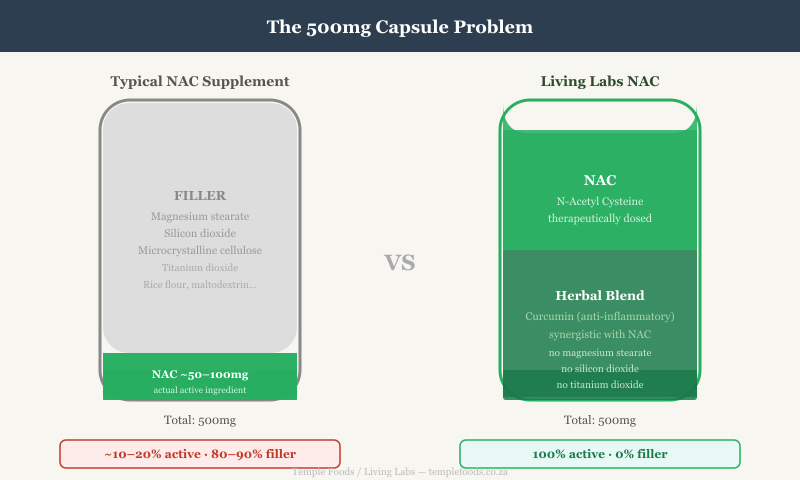
Pick up any supplement bottle. Look at the capsule size. It holds about 500mg of powder. Now look at the active ingredients on the label. Add them up. If they total 50mg, the other 450mg is filler. You just bought a bottle of magnesium stearate with a sprinkle of what you actually wanted.
This matters more for NAC than almost any other supplement — because NAC's job is serious. N-Acetyl Cysteine is a precursor to glutathione, the most important antioxidant your body produces. It's used in hospitals to treat paracetamol overdose. It's researched for lung disease, liver protection, psychiatric conditions, and fertility. This is a compound with real power.
But here's what most NAC marketing won't tell you: the mainstream narrative about why NAC works is incomplete. And the incomplete narrative leads people to buy a supplement they might not need — while missing the one they almost certainly do.
The Lie the Industry Keeps Repeating
Open any NAC product page or supplement education site. You'll read some version of this: "Cysteine is the rate-limiting factor in glutathione synthesis. NAC supplements cysteine. Therefore NAC boosts glutathione."
The problem? It's not entirely true.
Cysteine can be rate-limiting in specific clinical conditions — liver disease, paracetamol toxicity, severe oxidative stress. In those contexts, NAC is genuinely lifesaving. But in the general population of people buying NAC capsules online? The research increasingly points to glycine as the actual rate-limiting factor.
A landmark paper in The Journal of Nutrition (Sekhar et al., 2011) found that supplementing glycine — not cysteine — was the key intervention that actually increased glutathione synthesis in older adults. A 2021 study in Nature Communications (Kumar et al.) found that GlyNAC (glycine + NAC combined) reversed nine hallmarks of aging in older humans, outperforming NAC alone across every measured marker.
So why does every NAC bottle tell you cysteine is the bottleneck? Because it sells NAC. The glycine story doesn't have the same marketing appeal. Glycine is cheap, boring, and tastes slightly sweet. NAC has a compelling hospital-grade backstory and a much higher profit margin.
The Neodymium Magnet Problem
Cysteine — the amino acid NAC delivers — is not just any building block. It contains a sulphur group (a thiol, –SH) that makes it one of the most chemically reactive amino acids in the body. Think of pure cysteine like a bare neodymium magnet dropped on a factory floor: incredibly powerful, but causing chaos everywhere it lands — sticking to things it shouldn't, disrupting processes it wasn't meant to touch.
Glutathione is that neodymium magnet properly encased in a protective shell. The glycine and glutamate surrounding the cysteine core don't dilute the power — they channel it. With the casing in place, the magnet does exactly what you want: neutralises free radicals, escorts toxins out of cells, regenerates other antioxidants. Without the casing, the raw cysteine is too reactive to be useful.
As the saying goes: with great power comes great responsibility. Cysteine has extraordinary power. Glutathione is cysteine being responsible.
Or think of it this way: petrol is dangerous in an open container. It corrodes, evaporates, and one spark away from destruction. Inside a combustion engine — with the right structure, timing, and compression — it runs the world. NAC delivers the fuel. But without the engine components (glycine, glutamate, the right enzymes), the fuel sits unused or causes problems.
The Full Pathway: How Glutathione Actually Gets Made
Most NAC articles gloss over the biochemistry. Let's not. Understanding this pathway is what separates intelligent supplementation from expensive guesswork.
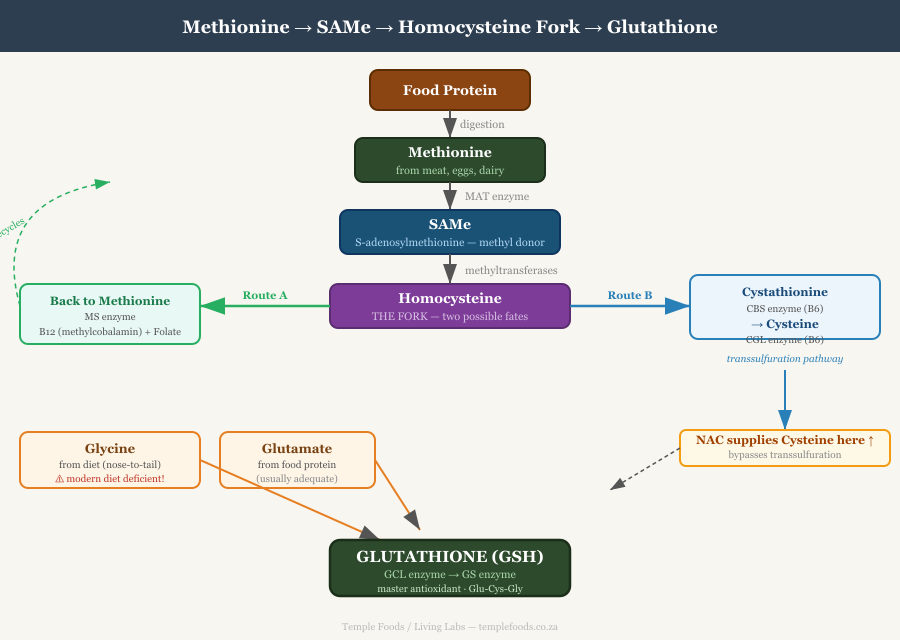
Step 1: Food protein → Methionine
You eat protein — meat, eggs, dairy, legumes. Your body breaks it down into amino acids. One of the most important is methionine, found abundantly in eggs, meat, and fish.
Step 2: Methionine → SAMe (via MAT enzyme)
The enzyme methionine adenosyltransferase (MAT) converts methionine into S-adenosylmethionine, better known as SAMe. SAMe is your body's primary methyl donor — it powers over 200 methylation reactions including DNA repair, neurotransmitter synthesis, and gene expression.
Step 3: SAMe → Homocysteine (via methyltransferases)
After donating its methyl group, SAMe becomes homocysteine. This is the crossroads — the most important fork in the entire pathway.
Step 4: The Fork in the Road
Homocysteine has two possible fates:
- Route A — Back to Methionine: The enzyme methionine synthase (MS) uses vitamin B12 and folate (as methylcobalamin and methyltetrahydrofolate) to remethylate homocysteine back into methionine. This recycles the methionine pool and keeps the methylation cycle running.
- Route B — Forward to Cysteine: The enzyme cystathionine beta-synthase (CBS) uses vitamin B6 to convert homocysteine into cystathionine, then into cysteine via cystathionine gamma-lyase (CGL). This is called the transsulfuration pathway.
Step 5: Cysteine + Glycine + Glutamate → Glutathione
Cysteine from transsulfuration (or from NAC supplementation) combines with glycine and glutamic acid (glutamate) in a two-step enzymatic process:
- Gamma-glutamylcysteine ligase (GCL) joins glutamate + cysteine → gamma-glutamylcysteine
- Glutathione synthetase (GS) joins gamma-glutamylcysteine + glycine → Glutathione (GSH)
Notice what's required at the final step: glycine. And notice what most NAC supplements don't contain.
The Glycine Deficit: Why Your Ancestors Didn't Have This Problem
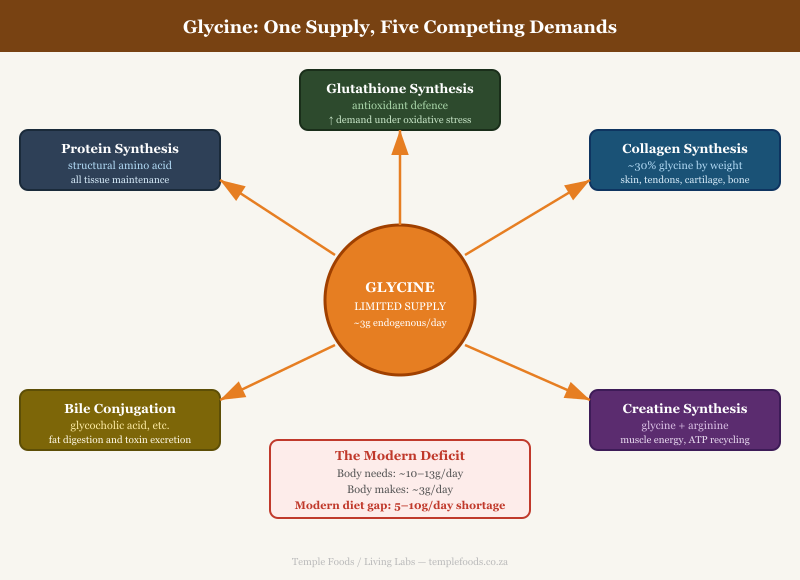
Your body needs approximately 10–13 grams of glycine per day for all its functions. It's used for:
- Glutathione synthesis
- Collagen synthesis (glycine is roughly 30% of collagen by amino acid content)
- Protein synthesis across all tissues
- Bile salt conjugation (bile acids are conjugated with glycine or taurine for excretion)
- Creatine synthesis (glycine + arginine → guanidinoacetate → creatine)
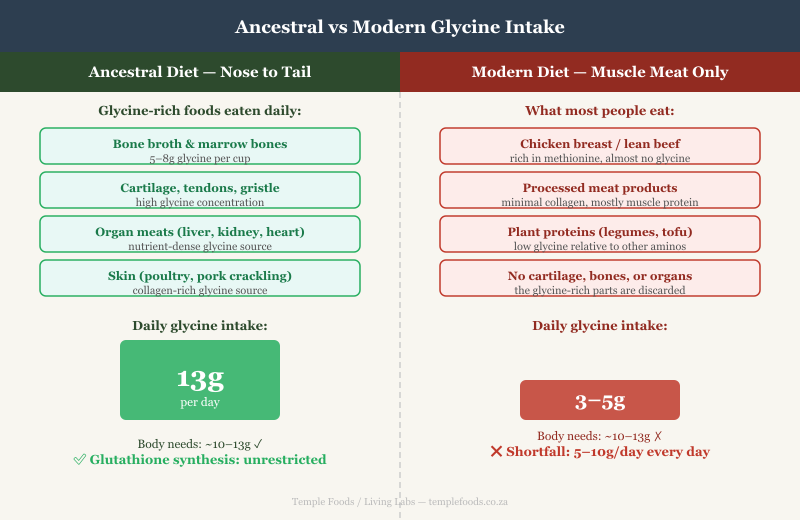
Here's the problem: your body can only synthesise about 3 grams of glycine per day endogenously. The rest must come from diet. And the modern diet is catastrophically short.
Your ancestors ate nose-to-tail. Cartilage. Bone broth. Skin. Tendons. Organ meats. These are the glycine-rich parts of the animal — the connective tissues that we've almost entirely eliminated from the modern Western diet. A traditional diet easily delivered 10–15 grams of glycine daily from these sources.
Today, we eat muscle meat. Chicken breast. Lean steak. Pork loin. Muscle meat is rich in methionine but almost completely devoid of glycine. The result: a population running a glycine deficit of 5–10 grams per day, every single day.
Now consider what happens when glutathione synthesis is already glycine-limited, and you flood the system with more cysteine via NAC. The cysteine arrives at the final assembly step. It waits. There's no glycine. It can't be incorporated. The bottleneck isn't relieved; it just moves slightly upstream.
This is the core argument against NAC-first supplementation in healthy adults: you haven't identified which component is rate-limiting. If it's glycine, NAC alone won't move the needle.
Does cysteine have the same depletion story? No — and this is important. Unlike glycine, cysteine isn't lost from nose-to-tail eating. Muscle meat contains methionine, which via transsulfuration becomes cysteine. Even on a modern muscle-meat diet, cysteine supply is reasonable. The dietary shift that depleted glycine did not equivalently deplete cysteine. So supplementing the already-adequate precursor while ignoring the depleted one is exactly backwards.
The MTHFR Connection
Approximately 10–15% of people carry the C677T MTHFR polymorphism in homozygous form, with another 40–50% carrying at least one copy. MTHFR (methylenetetrahydrofolate reductase) is the enzyme that converts folate into the active form needed for the methylation cycle.
When MTHFR is impaired, homocysteine can't be efficiently remethylated back to methionine (Route A is compromised). The body compensates by pushing more homocysteine through transsulfuration (Route B). This sounds like it should help glutathione — more cysteine flowing through — but MTHFR impairment often coincides with broader metabolic dysfunction that reduces overall glutathione synthesis efficiency.
People with MTHFR variants tend to have chronically elevated homocysteine, increased oxidative stress, and lower glutathione levels. Research suggests that impaired methylation and its downstream consequences — including reduced glutathione — may be associated with significantly shortened healthspan. Some estimates suggest the metabolic consequences of severe MTHFR impairment can be substantial, though the precise figure varies by study design and population.
For MTHFR-positive individuals, the supplement hierarchy is clear: methylated B vitamins first (methylcobalamin + methylfolate to support Route A), glycine second (to ensure the final glutathione assembly step isn't rate-limited), and NAC as a useful adjunct — not the foundation.
What to Actually Do: The Right Stack
None of this means NAC is useless. It means the sequence matters.
Priority 1 — Glycine: 3–5g daily. Cheap, tasteless, dissolves in anything. Fixes the actual dietary deficit. Addresses the rate-limiting step most people in the modern population are actually hitting.
Priority 2 — Vitamin C: Take alongside glycine. Vitamin C is essential for collagen synthesis (it hydroxylates proline and lysine residues), which competes with glutathione synthesis for glycine. Keeping collagen synthesis well-supported reduces the glycine competition pressure.
Priority 3 — NAC: Now it makes sense. You've addressed the glycine deficit. You've supported collagen. Now adding NAC gives the system additional cysteine — at a point when glycine isn't the bottleneck. This is when NAC earns its keep.
Living Labs' NAC formulation doesn't just contain raw NAC. We include an herbal blend with curcumin alongside the NAC — so instead of the other 450mg in your capsule being magnesium stearate, it's doing something. Anti-inflammatory curcumin pairs naturally with NAC's antioxidant mechanism. That's the 500mg capsule being used honestly.
Supplements You Should Actually Feel
One principle I use to prioritise supplementation: take things you can feel working within weeks. That feedback loop matters.
- B1 (Thiamine): Subclinical deficiency is widespread, especially in people who drink alcohol, eat refined carbohydrates, or take metformin. Many people describe the first week on a proper B1 dose as "the lights coming on." Energy, mental clarity, mood — you feel it.
- L. reuteri: A specific probiotic strain linked to oxytocin production, improved sleep quality, and social bonding. A meaningful percentage of users notice sleep improvement within 2–3 weeks.
- Glycine (again): Skin texture improvements within 4–6 weeks are commonly reported — because glycine is foundational to collagen. You see it in your fingernails and skin before you measure it in a lab.
- Methylated B vitamins: For anyone who's a poor methylator (MTHFR variant), switching from folic acid to methylfolate can produce noticeable mood, energy, and cognitive improvements within days to weeks.
- D3+K2: If you're deficient (most indoor South Africans are), mood and energy improvements are often dramatic within 2–4 weeks.
Where does NAC sit on this felt-benefit scale? For most healthy adults: modest. It's working in the background on oxidative stress pathways that don't produce immediate subjective feedback. That doesn't mean it's not valuable — it means it should come after the things that give you clear signal.
This Is the Glutathione Setup
This article is a precursor — both literally and structurally. We've traced the pathway from food protein all the way to the doorstep of glutathione synthesis. The next article in this series covers what glutathione actually does once it's made: the recycling system (glutathione reductase, NADPH), the phase II detoxification it enables in the liver, why it's the master antioxidant that regenerates vitamins C and E, and what depletes it fastest in modern life.
Understanding NAC makes no sense without understanding glutathione. Understanding glutathione makes no sense without understanding the pathway we've just walked through. This is the foundation. The next article is the building.
Scientific References
- Sekhar RV et al. (2011). Deficient synthesis of glutathione underlies oxidative stress in aging and can be corrected by dietary cysteine and glycine supplementation. The American Journal of Clinical Nutrition, 94(3):847–853. PMID: 21795440
- Kumar P et al. (2021). Glycine and N-acetylcysteine (GlyNAC) supplementation in older adults improves glutathione deficiency, oxidative stress, mitochondrial dysfunction, inflammation, insulin resistance, endothelial dysfunction, genotoxicity, muscle strength, and cognition. Nature Communications, 12:3151. doi:10.1038/s41467-021-23437-4
- Meister A (1988). Glutathione metabolism and its selective modification. Journal of Biological Chemistry, 263(33):17205–17208. PMID: 3053703
- Ristoff E, Larsson A (2007). Inborn errors in the metabolism of glutathione. Orphanet Journal of Rare Diseases, 2:16. PMID: 17391511
- Bannai S, Tateishi N (1986). Role of membrane transport in metabolism and function of glutathione in mammals. Journal of Membrane Biology, 89(1):1–8. PMID: 3512943
- Stanger O (2002). Physiology of folic acid in health and disease. Current Drug Metabolism, 3(2):211–223. PMID: 12003352
- Frisco S et al. (2002). A dose-response relationship between homocysteine and folate: from in vitro studies to clinical observations. Clinica Chimica Acta, 326(1–2):11–23. PMID: 12417099
- Ames BN (2018). Prolonging healthy aging: Longevity vitamins and proteins. Proceedings of the National Academy of Sciences, 115(43):10836–10844. PMID: 30322941
Frequently Asked Questions
Is NAC a waste of money?
Yes, if you take it on its own. NAC in isolation is a waste of money, and it can be worse than a waste. If glycine is the thing you are actually short of, you are shoving cysteine into a factory that has run out of the other half, and unpartnered cysteine is not something you want accumulating. So on its own it can do harm, not merely nothing. Your body rate limits cysteine production for a reason (it can cause oxidative and free radical damage exactly the opposite of glutathione)
No, it is not a waste if you take it alongside the things that let it work, especially methylated B vitamins and glycine. Give the factory both raw materials and the methylation machinery to run them, and NAC earns its place properly.
How much glycine do I actually need to supplement?
The GlyNAC research used 1.33 mmol/kg/day of glycine, roughly 100 mg/kg, so about 7.5 g/day for a 75 kg person. Starting at 3 to 5 g daily is practical and meaningful.
But do not be timid with it. Glycine is one of the easiest things in the world to take, it tastes mildly sweet, and it has no established upper tolerable intake limit, so 10 to 15 g a day is perfectly reasonable and is what I would aim for. Stir it into coffee, tea, water, or a protein shake and you will barely notice it. Collagen powder is another source, roughly 30% glycine by weight.
Can I take NAC and glycine together?
Yes — this is actually the studied combination. The GlyNAC research in older adults used both simultaneously. If you're using NAC, adding glycine at the same time removes the rate-limiting step that would otherwise blunt NAC's effect. Living Labs sells both separately so you can stack them appropriately.
Does NAC interact with medications?
Potentially. NAC has anticoagulant properties and may potentiate blood thinners. It's been studied alongside nitroglycerin for angina. At high doses it can reduce the effectiveness of certain chemotherapy agents. If you're on any prescription medication, especially anticoagulants, immunosuppressants, or chemotherapy, discuss with your doctor before supplementing.
Why does NAC smell like rotten eggs?
The sulphur in the cysteine thiol group (–SH) is responsible. This is the same chemistry that makes garlic and onions pungent. High-quality NAC in a properly sealed capsule shouldn't be noticeable, but if you open the capsule or the product is old and poorly sealed, you'll encounter it. The odour is normal, not a sign of spoilage.
Will NAC help with my skin?
Indirectly, through glutathione's role in reducing oxidative damage. But for direct skin structural improvement — collagen, elasticity, skin thickness — glycine + vitamin C is the more direct intervention. Glutathione does have a skin-lightening effect at high doses, which is why it's used in some cosmetic contexts, but this is different from the general skin health question most people are asking.
Is Living Labs NAC good quality?
Living Labs NAC includes an herbal blend with curcumin so that the non-NAC content of the capsule isn't wasted filler. No magnesium stearate, no silicon dioxide, no titanium dioxide. It's a supplement designed around the 500mg capsule problem — making every milligram count. Whether NAC is the right first step for you is a separate question from whether the product is high quality. It is.